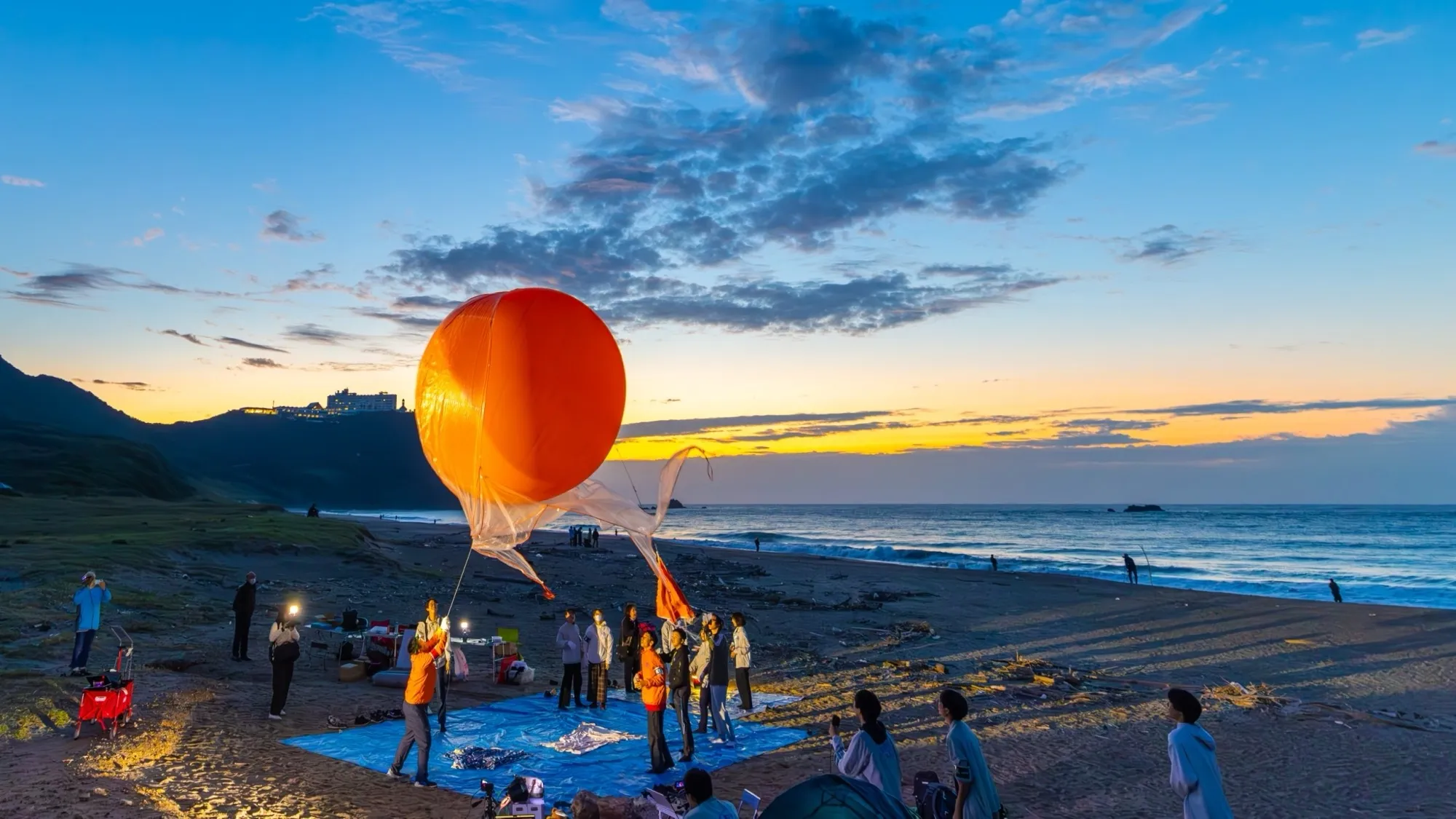
Space Balloon
Reaching 30 km with 100 students and nine partner organizations
A team of nearly 100 Astronomy Club students designed, built, and launched a stratospheric balloon to an altitude of 30 km, working with nine companies and organizations, including Sony Semiconductor Solutions Corporation. The payload carried cameras on both its top and bottom surfaces.
I worked on project management and, as a member of the communications team, on analysis of data transmitted during the flight, live mission broadcasts to the school, and team coordination throughout several months of preparation. The project received a National Excellence Award at the National High School Student Project Awards and the school’s Asahigaoka Cultural Award.
The payload was built around a Sony SPRESENSE board running on Arduino IDE, chosen because it is rated for the low temperature and low pressure of the stratosphere and draws very little power. It carried a BME280 temperature, pressure, and humidity sensor mounted outside the enclosure with an auto-calibration routine, a Geiger counter for atmospheric radiation, and an ELTRES add-on board that transmitted GNSS and sensor data to the ground in real time. Two GoPro HERO7 cameras ran off external battery packs, because sealing them at altitude traps their own heat and stops recording.
Recovery was the hard constraint: a payload that lands in the sea and cannot be found is a total loss. On the communications team, I worked on tracking with two independent systems — ELTRES telemetry plus a GARMIN positioning unit floated inside the foam so its antenna always points skyward after splashdown — so a single failure could not cost us the flight data. The team designed the foam housing below 1.0 g/cm³ so it would float, sealed it with silicone, painted it in fluorescent color, and printed contact details on the outside in case someone else found it first.
Everything had to survive roughly −60 °C. We insulated the electronics enclosure with Neoma Foam and verified it in a thermostatic chamber, where the components inside kept running at −60 °C. The frame also carried an analog gimbal built from PVC pipe to damp the balloon’s rotation and steady the camera image, with tensioned cord threaded inside the pipe so the payload would not fall even if a pipe cracked — carbon fiber would have been better, but it was outside our budget.
The project ran from its start in November 2023 through launch: securing technical cooperation from Sony Semiconductor Solutions Corporation and the school’s approval, exhibiting at Kagaku Zanmai in Aichi 2023, partnering with Professor Emeritus Yoshiyuki Mizuno of Kyoto Women’s University, gaining SSH approval, and then prototyping, drop-testing payloads from the fourth floor of the school building, and durability testing before the final build.
Next project
Lobby Shelf